
CLINICAL EMBRYOLOGY: WHAT DOES A CLINICAL EMBRYOLOGIST DO? | RARTAI
Behind every IVF treatment is a highly specialized laboratory where human sperm, oocytes and embryos are carefully handled under controlled conditions.
Introduction
Behind every IVF treatment is a highly specialized laboratory where human sperm, oocytes and embryos are carefully handled under controlled conditions. The professionals responsible for much of this laboratory work are clinical embryologists.
Clinical embryology is a specialized field within reproductive medicine that focuses on the laboratory aspects of assisted reproductive technology (ART). Clinical embryologists work with human gametes and embryos during procedures such as in vitro fertilization (IVF), intracytoplasmic sperm injection (ICSI), embryo culture, embryo assessment and cryopreservation.
Although patients may interact primarily with fertility specialists and nursing teams, the embryology laboratory plays an essential role in the overall IVF process.
So, what exactly does a clinical embryologist do?
From handling oocytes and sperm to monitoring fertilization, culturing embryos and maintaining laboratory quality systems, the role involves a combination of scientific knowledge, technical skill, precision and strict adherence to laboratory protocols.
What Is Clinical Embryology?
Clinical embryology is the application of reproductive biology, developmental biology, cell biology and laboratory science to the clinical management of human gametes and embryos. It forms an important part of assisted reproductive technology.
A clinical embryology laboratory may be involved in:
- Sperm preparation
- Oocyte identification and handling
- Conventional IVF
- ICSI
- Fertilization assessment
- Embryo culture
- Embryo assessment
- Blastocyst culture
- Embryo cryopreservation
- Oocyte cryopreservation
- Embryo warming
- Embryo biopsy
- Preimplantation genetic testing (PGT)
- Laboratory quality management
- Identification and traceability
The exact scope of an embryologist's responsibilities depends on the laboratory, clinical setting, training and procedures offered by the fertility center.
Who Is a Clinical Embryologist?
A clinical embryologist is a trained laboratory professional who works with reproductive cells and embryos in an assisted reproduction laboratory.
Their work requires an understanding of:
- Human reproductive biology
- Gametogenesis
- Fertilization
- Early embryonic development
- Cell biology
- Microscopy
- Embryo culture
- Cryobiology
- Laboratory quality management
- Assisted reproductive technologies
Clinical embryologists work closely with fertility specialists, andrologists, nurses and other members of the reproductive medicine team.
The role is highly detail-oriented because gametes and embryos are handled at microscopic scales and laboratory conditions need to be carefully controlled.
What Does a Clinical Embryologist Do in an IVF Laboratory?
The responsibilities of a clinical embryologist can extend across almost the entire laboratory component of an IVF cycle.
1. Sperm Preparation
Sperm samples may require laboratory processing before being used for insemination or ICSI. Depending on the clinical and laboratory protocol, embryologists may process semen samples to obtain an appropriate sperm population for the planned procedure.
This can involve: Sample assessment, Sperm concentration assessment, Motility assessment, Sperm preparation, Selection of an appropriate sperm population.
The specific method used depends on the sample characteristics and clinical treatment plan.
2. Oocyte Identification and Handling
Following oocyte retrieval, follicular fluid is examined in the laboratory to identify cumulus-oocyte complexes. Embryologists identify and carefully handle the recovered oocytes. Oocytes are sensitive biological structures, and laboratory handling needs to minimize unnecessary exposure to inappropriate environmental conditions.
Important laboratory parameters include: Temperature, pH, Osmolality, Gas conditions, Culture media, Environmental stability.
The European Society of Human Reproduction and Embryology (ESHRE) recommendations emphasize appropriate control and monitoring of laboratory conditions during the handling and culture of gametes and embryos. [1]
3. Conventional IVF
In conventional IVF, prepared sperm and oocytes are placed together under controlled laboratory conditions to allow fertilization to occur. The embryologist is responsible for preparing the laboratory procedure, monitoring the process and subsequently assessing the oocytes for evidence of fertilization.
This requires careful control of: Sperm preparation, Oocyte handling, Insemination conditions, Culture environment, Identification and traceability, Fertilization assessment.
4. ICSI – Intracytoplasmic Sperm Injection
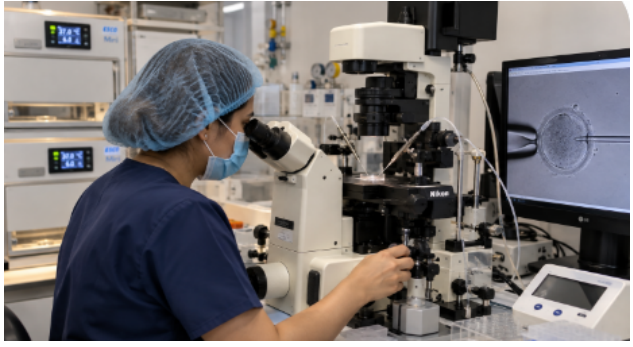
One of the most technically demanding procedures performed by trained embryologists is intracytoplasmic sperm injection (ICSI). During ICSI, a single sperm is selected and injected directly into the cytoplasm of a mature oocyte using specialized micromanipulation equipment.
The procedure requires: An inverted microscope, Micromanipulation equipment, Holding and injection pipettes, Specialized laboratory workstations, Precise hand-eye coordination, Appropriate training and experience.
The embryologist must carefully manipulate the oocyte and sperm while minimizing mechanical and environmental stress. ICSI is an important example of how clinical embryology combines biological knowledge with advanced laboratory technology.
5. Fertilization Assessment
After IVF or ICSI, embryologists assess the oocytes to determine whether normal fertilization has occurred. A commonly assessed feature is the presence of two pronuclei (2PN), representing the maternal and paternal pronuclear genomes following fertilization. Embryologists also document abnormal fertilization patterns when observed.
Accurate fertilization assessment is important because it determines which embryos proceed through subsequent stages of laboratory culture. The updated ESHRE recommendations include specific guidance regarding fertilization assessment and abnormal fertilization patterns. [1]
6. Embryo Culture
Following fertilization, embryos are cultured in specialized laboratory systems. Embryo culture is one of the central responsibilities of a clinical embryologist. The laboratory aims to maintain a stable environment that supports embryo development.
Factors that may require monitoring include: Temperature, pH, Gas concentrations, Osmolality, Culture media, Incubator performance, Environmental conditions.
Embryologists monitor embryos at appropriate developmental stages and document their development according to laboratory protocols. Modern IVF laboratories increasingly use advanced incubators, time-lapse imaging systems and digital monitoring technologies to support laboratory workflow and quality management.
7. Embryo Assessment and Grading
Embryologists assess embryos based on their developmental progression and morphological characteristics.
At the cleavage stage, observations may include: Cell number, Cell organization, Fragmentation, Symmetry, Developmental progression.
At the blastocyst stage, assessment may include: Degree of blastocoel expansion, Inner cell mass characteristics, Trophectoderm characteristics.
One commonly used system for blastocyst assessment is the Gardner and Schoolcraft grading approach. [2] However, embryo morphology should not be interpreted as a guarantee of implantation, pregnancy or live birth. Embryo assessment is one component of the broader clinical decision-making process.
8. Blastocyst Culture
Some embryos are cultured beyond the cleavage stage until they reach the blastocyst stage, typically around days 5–7 of development. The blastocyst contains distinct cellular components, including: Inner cell mass, Trophectoderm, Blastocoel.
Embryologists monitor the developmental progression of embryos and assess blastocyst morphology according to validated laboratory procedures. Blastocyst culture requires reliable laboratory systems because embryos remain outside the human body for an extended period and are sensitive to environmental changes.
9. Embryo Cryopreservation
Clinical embryologists may also perform embryo cryopreservation, allowing embryos to be stored for future use. Modern reproductive laboratories commonly use vitrification, a rapid cryopreservation method that minimizes ice crystal formation.
The cryopreservation workflow can involve: 1. Embryo preparation, 2. Exposure to cryoprotective solutions, 3. Vitrification, 4. Storage, 5. Identification and documentation, 6. Future warming when clinically required.
Correct identification and traceability are particularly important during cryopreservation because multiple reproductive samples may be stored within the same laboratory.
10. Oocyte Cryopreservation
Oocytes can also be cryopreserved using vitrification. Oocyte vitrification requires specialized laboratory procedures because mature oocytes are sensitive to osmotic and temperature changes.
Embryologists involved in oocyte cryopreservation need appropriate training in: Oocyte handling, Cryoprotectant exposure, Vitrification, Storage, Warming, Post-warming assessment.
11. Embryo Warming
When a cryopreserved embryo is required for treatment, it undergoes a controlled warming procedure. Embryologists carefully manage the warming process and subsequently assess the embryo. The laboratory records the relevant information associated with the embryo, including identification, storage information and laboratory observations.
12. Embryo Biopsy and Preimplantation Genetic Testing
Some IVF programs offer preimplantation genetic testing (PGT). Embryo biopsy involves removing a small number of cells from an embryo, usually at the blastocyst stage, for genetic analysis.
The biopsy process requires: Specialized microscopy, Micromanipulation, Appropriate biopsy equipment, Validated laboratory procedures, Accurate sample identification, Coordination with the genetics laboratory.
PGT may be categorized into areas such as: PGT-A (testing related to embryo chromosome number), PGT-M (testing for specific monogenic conditions), PGT-SR (testing related to structural chromosomal rearrangements).
The suitability and clinical use of PGT depend on individual circumstances and should be discussed with an appropriately qualified fertility and genetics team. ESHRE's updated IVF laboratory recommendations include specific guidance on embryo biopsy. [1]
13. Laboratory Quality Management
A clinical embryologist's work extends beyond manipulating gametes and embryos. Quality management is a fundamental part of modern IVF laboratory practice.
An embryology laboratory may monitor: Equipment performance, Incubator conditions, Culture conditions, Environmental parameters, Quality control results, Reagent and media records, Sample identification, Cryostorage, Deviations, Documentation, Staff competency, Laboratory performance indicators.
Standard operating procedures (SOPs) help ensure that procedures are performed consistently.
14. Identification and Traceability
One of the most important responsibilities in an IVF laboratory is ensuring that reproductive material is correctly identified throughout the laboratory workflow. Embryologists may handle: Sperm samples, Oocytes, Embryos, Cryopreserved embryos, Cryopreserved oocytes, Biopsy samples.
Errors in identification can have serious consequences. Therefore, laboratories use systems such as: Double witnessing, Electronic witnessing, Barcode systems, Electronic identification systems, Defined documentation procedures.
The American Society for Reproductive Medicine (ASRM) emphasizes the importance of witnessing and identification systems at critical points in IVF and andrology laboratory workflows. [3]
15. Working With the Clinical Team
Clinical embryologists are part of a multidisciplinary fertility team. They may communicate with: Reproductive medicine specialists, Gynecologists, Andrologists, Nurses, Genetic specialists, Laboratory managers, Quality personnel. The clinical team manages the patient's medical treatment, while the embryology team manages the laboratory component of assisted reproduction. Effective communication between these teams is essential.
What Skills Does a Clinical Embryologist Need?
Clinical embryology requires more than academic knowledge. A successful embryologist needs a combination of scientific, technical and professional skills.
- Scientific Knowledge: A strong foundation in reproductive biology, embryology, genetics, cell biology, developmental biology, andrology.
- Microscopy Skills: Embryologists work with specialized microscopes and imaging systems and need excellent visual observation skills.
- Micromanipulation Skills: Procedures such as ICSI and embryo biopsy require precise micromanipulation.
- Attention to Detail: Small differences in developmental stage, laboratory conditions or documentation can be important.
- Laboratory Discipline: Embryologists must consistently follow SOPs, quality systems and safety procedures.
- Problem-Solving: Laboratory professionals may need to respond appropriately to equipment alerts, culture issues or unexpected observations according to validated procedures.
- Documentation: Accurate documentation is essential for laboratory traceability and quality management.
Clinical Embryology and Technology
Clinical embryology is increasingly influenced by technological developments. Modern IVF laboratories may use technologies such as:
- Time-Lapse Imaging: Time-lapse systems can capture embryo development continuously without requiring frequent removal of embryos from controlled incubation conditions.
- Artificial Intelligence: AI-based systems are being investigated for applications including embryo image analysis, developmental assessment and prediction models. However, AI tools should be appropriately validated before being incorporated into clinical decision-making.
- Digital Witnessing Systems: Electronic witnessing and identification systems can help improve traceability and reduce risks associated with manual identification processes.
- Advanced Cryopreservation: Vitrification has become an important technology for cryopreservation of oocytes and embryos.
- Genetic Testing: Embryo biopsy and genetic testing have expanded the role of embryologists within multidisciplinary reproductive medicine teams.
Why Is Practical Training Important in Clinical Embryology?
Clinical embryology is a laboratory-based profession. Reading textbooks and attending lectures can provide the theoretical foundation, but many embryology procedures require hands-on practical training and supervised laboratory experience.
For example, learning about ICSI theoretically is very different from developing the micromanipulation skills required to perform ICSI. Similarly, understanding embryo morphology from photographs is different from routinely assessing embryos through a microscope in a clinical laboratory.
A structured training program should therefore combine: Theory + Demonstration + Supervised Practice + Observation + Assessment. This approach helps students develop both scientific understanding and practical laboratory skills.
How Can You Become a Clinical Embryologist?
The pathway can vary depending on the country, institution, educational background and applicable professional requirements.
Students interested in clinical embryology generally benefit from a strong foundation in biological or life sciences followed by specialized training in reproductive science and assisted reproduction.
Relevant areas of training may include: Human reproductive biology, Embryology, Andrology, IVF, ICSI, Embryo culture, Embryo assessment, Cryopreservation, Micromanipulation, PGT concepts, IVF laboratory quality management, Laboratory safety, Documentation and traceability.
For students considering a career in this field, it is important to evaluate programs based on curriculum, faculty expertise, practical exposure, laboratory access and the qualifications required for the intended career pathway.
Career Opportunities in Clinical Embryology
Clinical embryology can provide opportunities across several areas of reproductive medicine and laboratory science.
Potential work environments include: IVF centers, Fertility hospitals, Assisted reproduction laboratories, Research laboratories, Academic institutions, Cryopreservation laboratories, Reproductive genetics laboratories, Fertility laboratory management.
Career progression may involve increasing responsibility in areas such as: Trainee Embryologist → Embryologist → Senior Embryologist → Laboratory/Scientific Leadership. The exact job titles and requirements vary between organizations and jurisdictions.
The Future of Clinical Embryology
The field of clinical embryology continues to evolve.
Future IVF laboratories are likely to increasingly integrate: Artificial intelligence, Advanced imaging, Time-lapse embryo monitoring, Digital witnessing, Laboratory automation, Advanced cryopreservation, Genetic technologies, Data-driven quality management.
However, technology does not replace the need for appropriately trained embryologists. Instead, the role of the embryologist is evolving from traditional laboratory handling toward a combination of reproductive biology, advanced laboratory technology, data interpretation and quality management.
Why Clinical Embryologists Matter in IVF
IVF is a multidisciplinary process. The fertility specialist, nursing team, embryology team, laboratory personnel and other professionals all contribute to patient care.
The clinical embryologist is responsible for a critical part of this pathway: maintaining and handling reproductive cells and embryos under carefully controlled laboratory conditions.
From the moment an oocyte enters the laboratory to fertilization, embryo culture, assessment and cryopreservation, embryologists contribute to the laboratory side of the treatment process.
Their work requires: Precision. Consistency. Scientific knowledge. Technical expertise. Quality management. Patient-centered responsibility.
Conclusion
Clinical embryology is a specialized and rapidly evolving field within assisted reproductive technology.
A clinical embryologist may be involved in sperm preparation, oocyte handling, IVF, ICSI, fertilization assessment, embryo culture, embryo grading, blastocyst culture, cryopreservation, embryo warming, embryo biopsy and laboratory quality management.
The profession requires a strong scientific foundation combined with practical laboratory skills and a commitment to quality and traceability.
As IVF technology continues to develop, clinical embryologists will increasingly work at the intersection of reproductive biology, laboratory science, genetics, imaging, cryobiology and artificial intelligence.
Explore Clinical Embryology with RARTAI
RARTAI focuses on developing knowledge and practical understanding in areas related to clinical embryology, assisted reproductive technology and reproductive science. If you are interested in building your knowledge and skills in clinical embryology, explore the RARTAI Clinical Embryology training and fellowship programs to learn more about available educational opportunities.
References
- Arroyo, G., Barrie, A., Coticchio, G., Ebner, T., Kirkman-Brown, J., Le Clef, N., ... & Sfontouris, I. (2026). ESHRE recommendations on Good Practice in the IVF laboratory. Human Reproduction, 41(8), 1245-1269.
- Gardner, D. K., & Schoolcraft, W. B. (1999). In vitro culture of human blastocysts. Towards reproductive certainty: fertility and genetics beyond, 1999, 378-388.
- Gracia, C., Flyckt, R., Sakkas, D., Hansen, K., Jain, T., Kalra, S., ... & Brooks, M. (2026). Witnessing and protocol deviations in the in vitro fertilization and andrology laboratory: a committee opinion. Fertility and Sterility.
- World Health Organization. (2025). Guideline for the prevention, diagnosis and treatment of infertility. World Health Organization.
- Reddy, K. R., Asif, M., Deotale, G., & Priya, V. G. S. (2026). Artificial intelligence in embryo selection: enhancing precision and overcoming traditional limitations in in vitro fertilization. International Journal of Reproduction, Contraception, Obstetrics and Gynecology, 15(2), 789–797. https://doi.org/10.18203/2320-1770.ijrcog20260214